Reset In Ties: Ajit Doval Meets Canadian Counterpart Amid Middle And Emerging Power Realignment

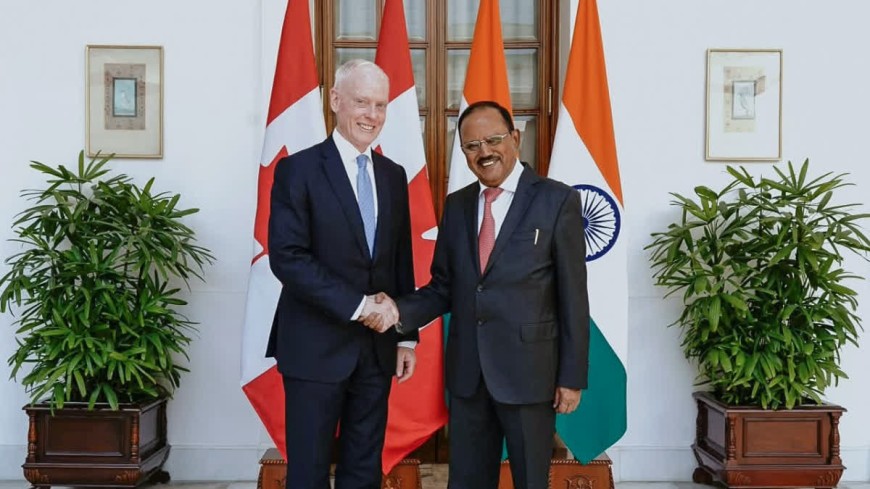
New Delhi: India and Canada agreed to explore new areas of security cooperation as the two countries moved forward on a larger political, security and trade reset amid strain in their respective relations with the US and a convergence over the need for countries like theirs to work together.
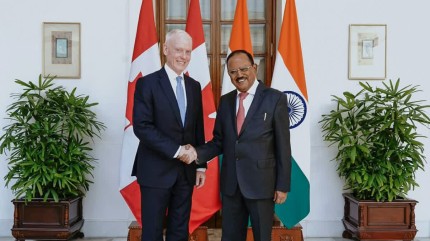
The meeting between National Security Adviser Ajit Doval and David Morrison, the Senior Diplomatic and International Affairs Advisor to the Prime Minister of Canada, signalled growing engagement in security ties, which were strained over intelligence and security matters not so long ago.
While the meeting was part of a regular bilateral security dialogue, the two sides agreed to identify additional areas for practical cooperation while reviewing progress in bilateral security and law enforcement cooperation, ANI reported.
But ties have since completely turned around after Trudeau's exit. The shift was evident during Canadian Prime Minister Mark Carney's India visit in February, when the two countries signed a $2.6 billion multi-year uranium supply pact and negotiated a General Security of Information Agreement related to safely sharing, handling, and protecting classified and sensitive government or military information.
Over the past eight months, the two sides have exchanged multiple visits at different levels. "I think we have seen remarkable positive momentum in Canada–India relations over the past year. What is particularly significant is that progress is now taking place across several tracks at the same time," said Vina Nadjibulla, co-founder and CEO of the Centre for Strategic Statecraft, a Canadian public policy think tank, to ETV Bharat.
She noted that there is "regular dialogue and progress on the more difficult security and law-enforcement issues that were at the centre of the breakdown in relations."
"The continuing high-level exchanges, including the meeting between Ajit Doval and David Morrison in India this week, are important evidence that the two governments are developing mechanisms to address these issues directly rather than allowing them to overwhelm the broader relationship," she noted.
But the reset in ties is also being aided by an uncertain geopolitical climate which is pushing both countries to renew relations. Under Carney, there has been not just a reset but also a convergence of worldview at a time when India and Canada both have had different trouble in their respective ties with the US under President Donald Trump.
Canada and the US are engaged in a worsening trade war, and India's own trade deal with the US appears to have hit a roadblock, with Finance Minister Nirmala Sitharaman saying both sides have reached a "plateau beyond which giving or taking might be very, very difficult." The US has also passed a law that allows Trump to impose up to a 100 per cent tariff on India, among others, for buying Russian oil.
Trade negotiations between the US and Canada broke down in August, resulting in mutual tariffs and import bans amid political friction. The US imposed 50 per cent tariffs on around $20 billion to $28 billion worth of Canadian goods.
Nadjibulla noted that in this backdrop there is "a larger strategic logic driving the rapprochement".
"Canada and India both have strong reasons to diversify their economic and strategic partnerships at a time when each is facing significant challenges in its relationship with its primary economic partner, the United States. That convergence of interests creates an opportunity to build a much more substantial relationship not only in trade and investment, but also in energy, critical minerals, technology and broader geopolitical cooperation," she said, adding, "The relationship still has difficult issues to manage, but the direction of travel is clearly positive and the pace of progress has been remarkable."
Carney’s doctrine of middle-power cooperation has also resonated with India, amid growing great power contestations and increasing uncertainty caused by the ongoing conflicts in Iran and Ukraine.
At the World Economic Forum in Davos in January, Carney said that amid a rupture in the world order due to great power rivalry, middle powers needed to work together, warning that a failure to do so would lead to countries negotiating from a position of weakness.
Echoing similar views, External Affairs Minister S. Jaishankar noted at the Munich Security Conference on Sunday that the US had "deliberately become a lonelier power" and observed that the world order is changing due to the repositioning of the US and the rise of China.
He noted that middle and emerging powers are consequently "focused on diversifying and de-risking in every sense of the term, not just their economy or their security, but also building more resilient supply chains."