Protests In France Are Symptom Of Fear And Anxiety Over Economic Future

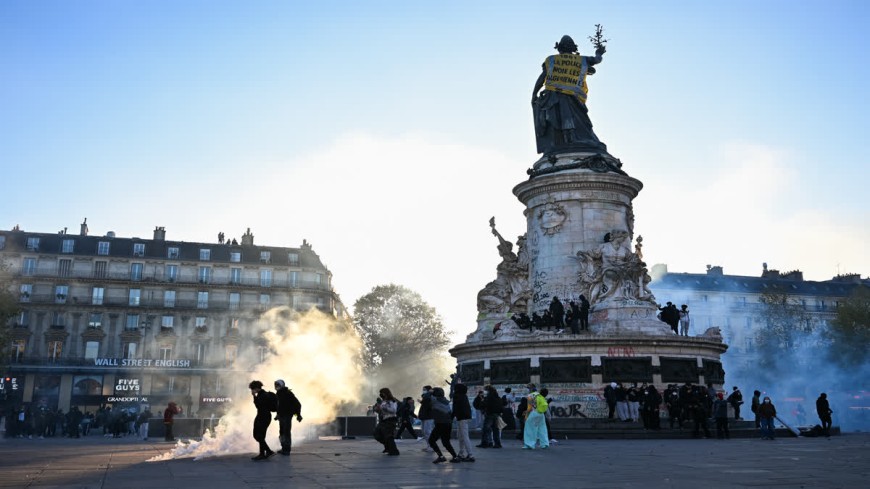
New Delhi: The protests this time round began with high school students bursting out onto the streets in late September, complaining about the shortage of teachers and dilapidated school buildings.
It seemed strange that the school-going youth should be out on the streets in large numbers – they were in the thousands – and it spread from Marseille in the south of the country to Paris and the rest of France.
Clashes occurred between the teenage protestors and the riot police at several locations. Government officials and ministers believed that the far-left party, France Unbowed, led by Jean-Luc Mélenchon, was instigating the protests.
But there was no plan to address the key issue even though officials acknowledged that the high schools, known as lycées in France, were in bad shape, particularly due to a lack of teachers.
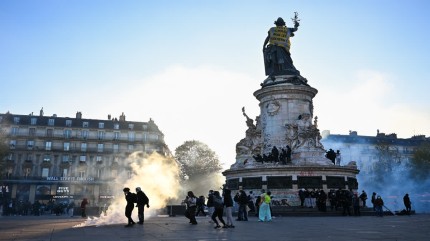
Over the weekend, the nationwide protest expanded and changed into a general protest against the cost of living and rising prices, with the government resorting to tear gas and water cannons. This expanded national protest also saw widespread violence as shops were looted, cars burned in Paris, and public buildings like town halls, some historic ones like in Lille, were also targeted.
No one is denying that the anger of the protestors, like that of the students before them, was legitimate. What President Emmanuel Macron, whose second and final term ends in May 2027, finds unacceptable is the looting and arson. He said in his televised address on Sunday, “Nothing justifies it, nothing explains it, nothing excuses it. Tonight we all feel anger and shame.”
Far-right leader and presidential hopeful Marine Le Pen will likely feel that the government's inability to address the protests will be politically advantageous but she has also criticised the violent protests. She highlighted that “violence is not an opinion" adding that "destruction is not a form of expression. And chaos cannot serve as a project for France.”
France is not unused to street protests and outbursts of violence. It can be traced back to the 1789 French Revolution, when a crowd of protestors attacked the Bastille, which housed political prisoners, on July 14, which is celebrated as Bastille Day, marking the fall of the monarchy.
So, when a protester in Marseilles shouts as the crowd forces its way into the mayoral office, “It’s the Revolution – we are taking the Bastille,” there is a misplaced sense of history reverberating among the protesters.
The French are unlike many others in Europe. For them, protests on the streets come more naturally than to many others in other countries. And student protests are not unfamiliar either. There were the famous 1968 student protests in Paris in the summer of 1968, which served as a live reference point for protesting students in France. And school students have protested in 1990, 1998, and 2006.
It was the student protest in 2006 which forced the government to withdraw a law of hire and fire passed by the National Assembly and signed by then president Jacques Chirac.
France is in a peculiar situation. It has memories of an imperial past with its colonies in North and West Africa, and in Indo-China in present-day Southeast Asia, which included Vietnam, Cambodia, Laos and a front-ranking European power. More than even the English, the French have prided themselves as a superior culture and civilisation.
These ingrained notions of superiority clash with the reality of a French economy that is lagging behind Europe’s economic powerhouse, Germany. Many sectors of the French economy are struggling, whether it is agriculture or services. France remains a hugely agricultural country in Europe.
Even its famed fashion sector faces tough competition from Italian brands. In many ways, France has fallen in the eyes of the French, and there is disappointment and anger in the hearts of a majority of the French.
They believe that the rich in France are having a good time even as they struggle to maintain their unaffordable living standards.
And there are real economic challenges which political parties and leaders are unable to resolve. The unemployment rate is 8.2 per cent, the budget deficit is running at over 5 per cent, and welfare state obligations like pensions form 57 per cent of its Gross Domestic Product. Any attempt to rationalise pensions is resisted vehemently.
French farmers demand protection from the entry of European Union agricultural imports. There is then an economic logjam and political parties, divided by the traditional left-right divide, spanning from far left to far right, are unable to find tough solutions to this hard reality because no single political formation is able to get the decisive majority in the parliamentary elections.
So, there are uneasy political coalitions, where the conservatives and centrists have been resisting aligning with either the leftists or the rightists. Like in many other European countries, the far right is gaining ground in France as well, as witnessed by the dominant position of National Rally led by Le Pen. But even Le Pen’s party does not command a majority. Le Pen is a strong contender for the presidency, but neither she nor her party have workable solutions to France’s economic woes.
The protests are symptoms of the fears and anxieties about the economic future among the students, and among the workers and the farmers. The French people are angry. The French High School Student Union, or Lyceens de l’Union nationale, head Ryad Rani said, “The government is trembling and it’s right to tremble because when the French people are angry, they never let up.”