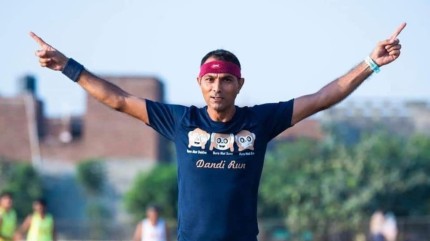
Meet The Running Monk, 54-Year-Old Marathoner Sanjay Panghal Has Built A 3,200-Day Running Streak

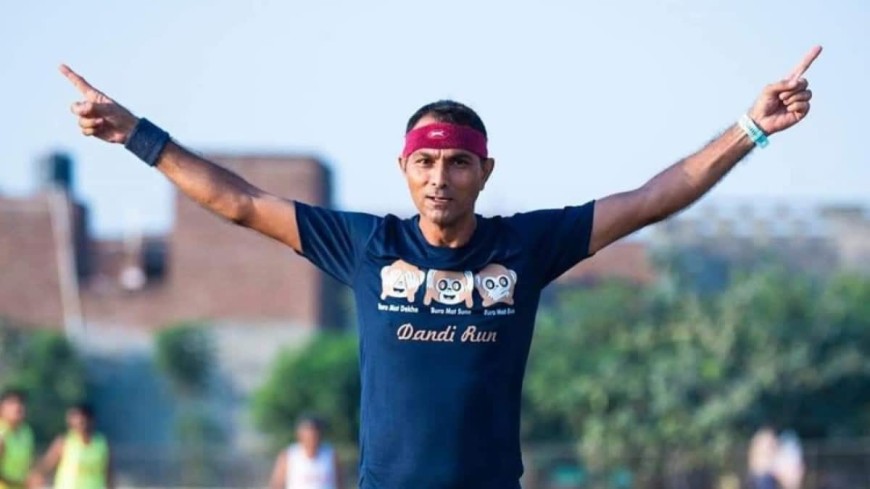
There are two kinds of people who wake up early in the morning. The first kind looks at the clock, decides that 10 more minutes of sleep are absolutely necessary for survival, and pulls the blanket over their head. The second kind gets out of bed, puts on their running shoes and heads out into the cold, dark morning. Sanjay Panghal belongs to the second set.
At 54, the Delhi-based marathon runner has run for more than 3,200 consecutive days. His current routine averages around 14 kilometres a day. Over the years, he says, he has accumulated more than 50,000 kilometres of running. His achievements include three Boston Marathon qualifications and finishes, a full marathon personal best of 3:13:36, a half marathon personal best of 1:30:50 and four Police Cup wins. He also finished third in the veteran category at the Ladakh Run in 2022 and has completed a 54-kilometre birthday run. He has personal records that many runners would love to achieve.
However, Panghal did not grow up dreaming of running marathons. In fact, he hated running. A former Indian Air Force serviceman who spent 20 years in uniform and now works with the Delhi Police, Panghal was an active sportsman long before he became a runner. He played kabaddi during his village and Air Force years, competed at command level, and played volleyball in school. Running, however, was something he would rather avoid. Today, he is known in running circles as the “Running Monk” and Bullet Runner on social media.
His philosophy is: you do not need to run a marathon every day to become fit. You need to show up, move your body and repeat the process until it becomes a part of your life. It sounds easy. Anyone who has tried to maintain an exercise routine for more than a week knows that it isn't.
Indian Air Force To The Delhi Police Running Club
Panghal's life in uniform helped shape his attitude towards discipline, but he has taken that discipline beyond his own running routine. He founded the Delhi Police Running Club and has introduced more than 300 police personnel and their family members to fitness through running. Police work can involve long hours, irregular schedules and demanding duties. A running community can make the first step less intimidating and give participants a shared reason to keep going.
Panghal has also helped build Dwarka Express Runners (DXR), a group that began with around 10 to 15 people. The initial members wanted to take part in races together and wear their own group T-shirts, much like the running clubs they saw at events. What started as a small gathering grew into a larger running community spanning different age groups.
The Man Who Initially Hated Running
Panghal's transformation began in 2017, when he was around 46. At the time, he was posted in the Delhi Police traffic unit, spending long hours outdoors amid dust, pollution and the everyday challenges of working on the roads. Eating and drinking safely while on duty could also be difficult.
He developed health problems, including jaundice and typhoid, and was overweight. For someone who had participated in sports since childhood, the situation was frustrating.
“It was very bad,” he tells ETV Bharat over Zoom. “I thought of doing something to get over these things and to be fit.” The first spark came from an unexpected source: a friend's Facebook post. The friend had completed a 21K run and proudly displayed his half-marathon finisher's medal. Panghal was intrigued. He had assumed that a medal meant the person had won the race. When he discovered that ordinary participants received them for completing the distance, he was curious enough to ask questions.
First Viral Moment
His friend encouraged him to register for a local 5K run in Dwarka, Delhi. Panghal agreed, although he had not trained for the event. On April 30, 2017, he turned up for the run. It was hot and humid, and he completed the five kilometres in approximately 26-27 minutes. The problem was what happened next.
“I was completely exhausted and lay down on the road after finishing,” he says. A Red Bull promotional team was present at the event. One of its representatives poured the drink into Panghal's mouth while he lay exhausted at the finish line and recorded a video. The clip went viral on the brand's Facebook page. For most people, collapsing after a 5K would be enough to reconsider the entire running idea. For Panghal, it became an introduction to a new world.
He began running shorter distances, gradually moving from two kilometres to three and then five. There was no sophisticated training plan, no personal coach and no curated fitness app telling him what to do next. He ran laps in a park and did some basic strength and core exercises.
Within his first year of running, he had completed a half marathon and then a full marathon. His first full marathon was in Mumbai, where he clocked three hours and 53 minutes. He was still learning about the sport, including something that experienced runners might consider obvious: the importance of appropriate footwear.
“I was running in shoes that cost a mere ₹700,” he says. “I had no knowledge about distance running shoes at that time.” He would eventually learn a great deal more about them. But first, he had discovered something more important: he actually enjoyed running!
From One Race To 3,200 Consecutive Days
In September 2017, while in Mumbai on official duty, Panghal searched online for a nearby running event. He found a 'Run for Rivers' event, registered and turned up to participate. He finished second overall in the 10K, clocking approximately 47 minutes. For someone who had once struggled to complete a warm-up run, this was a remarkable change. The following year, he began a more structured running journey through HDOR (Hundred Days Of Running), and running gradually became a fixture of his daily routine. The first 100-day challenge led to 200 days, then 300 days and eventually a year. The numbers kept growing.
His streak has now crossed 3,200 consecutive days. Yet he does not treat every day as an opportunity to break a personal record. “No target is in mind now. It's just today. I have to do it today, every day,” he says. On the morning of our interview in September, he had already completed 10 kilometres in 52 minutes before starting work. Panghal's streak is not a challenge to run 14 kilometres every day regardless of circumstances. His larger principle is consistency: the distance can vary, but the commitment to movement remains.
Why the Running Monk believes in consistency
The nickname “Running Monk” came from Panghal's philosophical way of talking about life and sport. A visiting running coach helped popularise it after watching him run at a pace the coach had not expected from his unassuming running form. His approach to running is less about the drama of a finish line and more about what happens on ordinary mornings when nobody is watching. Panghal's journey offers a different way to think about progress. A successful fitness routine need not depend on being motivated every single day. Running challenges helped him build structure, but he does not suggest that everybody needs a 100-day challenge or an unbroken streak. His own beginning was far from ideal. He ran his first 5K without preparation and was left completely exhausted. Today, he encourages beginners to learn from experience rather than repeat his mistakes.
Ask Panghal about running shoes, and the Running Monk becomes an enthusiast with a very specific subject to discuss. His early running days taught him that footwear was not an afterthought. Experienced runners warned him that unsuitable shoes could increase his risk of injury. He began asking questions and learning about different types of running shoes. There are shoes designed for road running, trail running and different kinds of training, including speed sessions and races. The right choice depends on factors such as fit, comfort, terrain and the runner's needs.
Panghal now owns around 18 pairs of running shoes. “My wife says I have more shoes than her saris,” he says with a laugh. It is an amusing domestic consequence of a hobby that began with a single pair of inexpensive shoes. A comfortable, properly fitting pair suited to the intended activity is a sensible starting point. Panghal learnt this through experience. He has dealt with plantar fasciitis (a painful condition affecting the tissue along the bottom of the foot).
Can You Start Running At 40, 50 or beyond?
Panghal began distance running at age 46. At 54, he continues to train, compete and encourage others to take up the sport. His story challenges the idea that fitness belongs mainly to the young or that a person must have been an athlete since childhood to make progress. His first 5K left him exhausted, and he had to learn the practical details of the sport along the way. The sensible approach for someone who believes they are too old or too unfit to begin is to start with an activity suited to your current ability. A run-walk can be an excellent starting point. Those who wish to run can introduce short intervals of jogging. People with existing medical conditions, significant joint problems or concerns about exercise should seek advice from a healthcare professional before beginning a demanding programme. Strength exercises, suitable footwear and a gradual increase in activity can help support progress.
As for Panghal, the man who once hated running, collapsed after his first 5K and wore inexpensive shoes to his first marathon now has thousands of consecutive days behind him. His most important achievement, however, may be the habit he built and the hundreds of other people he has encouraged to begin building their own.