Demand Grows In Madhya Pradesh For Return Of Gupta Empire Era Samudragupta Inscription From West Bengal Museum

Sagar: Following the inclusion of Eran in Madhya Pradesh's Sagar—a site rich in historical significance—in the Government of India’s list of "living cultural spaces," demand has grown in the state for the return of the ancient Samudragupta inscription dating back to the Gupta empire from a West Bengal museum.
Eran boasts a remarkable array of historical treasures, ranging from artifacts of the Chalcolithic (Copper Age) period—contemporary with the Harappan civilization—to exquisite examples of architecture from the Gupta period. Under the Government of India’s DESH (Development of Excavation Sites and Heritage Complexes) scheme, Eran has been selected as one of 15 archaeological sites across the country to be developed as a "living cultural space."
It houses temple ruins, statues, pillars and coins recovered through excavation work in this region. According to historians, these monuments and temples belong to the 5th to 6th century when this region was under the Gupta empire.
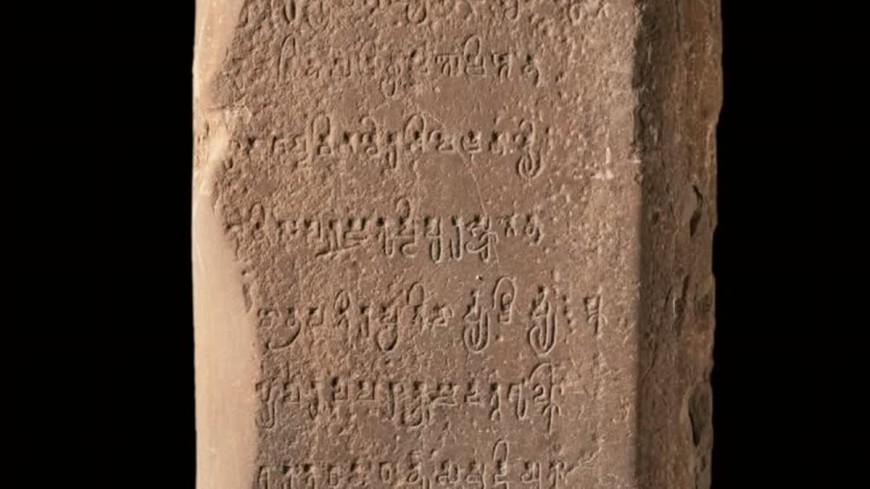
In light of this, there is growing demand to bring back to Eran the antiquities that were transported to museums in Kolkata and London during the British colonial era. Specifically, there is a strong demand to repatriate the inscription of Samudragupta, the second emperor of the Gupta empire, currently housed in the National Museum in Kolkata.
Archaeologists and public representatives have expressed a shared desire to see the glorious history of Eran restored to its original home.
Will Samudragupta’s Inscription Return From Kolkata Museum?
With Eran’s designation as a "living cultural space," local archaeologists and heritage enthusiasts are advocating for the return of the sculptures and antiquities that were taken away to other parts of the country or abroad. At the forefront of this effort is the call to bring back the inscription of Samudragupta.
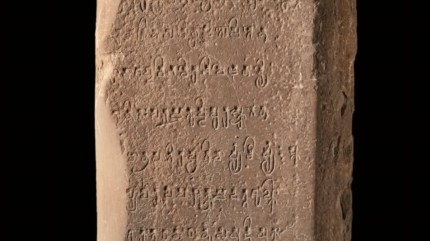
This inscription was originally discovered near the Vishnu temple in Eran. It was documented by a British officer General Alexander Cunningham in 1874–75. Cunningham, an engineer, gained renown as a scholar of Indian archaeology—through his book 'Tour Report: Bundelkhand and Malwa'.
The inscription was transported by Cunningham from Eran to Kolkata where it is currently housed in the National Museum. The inscription is written in the Brahmi script and the Sanskrit language, dating back to the Gupta period. It measures 9 inches in width and 3 feet 1 inch in height, with the engraved characters being half an inch in size.
What Is Written In The Samudragupta Inscription?
Prof Mohanlal Chadhar—a native of Eran and the Head of the Department of Ancient Indian History, Culture, and Archaeology at the Indira Gandhi National Tribal University, Amarkantak—explains that the inscription contains highly significant information.
According to Chadhar, it describes Samudragupta as being akin to Kubera (the god of wealth) in terms of valour, policy, and benevolence, while likening him to Yama (the god of death) when he is enraged. It highlights how Samudragupta enhanced his renown through his devotion, statecraft, and prowess, earning the title of 'Raja' (King).
The inscription compares his generosity in donating gold to that of the legendary kings Prithu and Raghava. It further states that Samudragupta conquered all the kingdoms across the earth, bringing prosperity to them. According to the text, his father, Chandragupta I, was so pleased with Samudragupta’s sense of justice and valor that he honored him by bestowing upon him the title of 'Raja' and appointing him as his successor.
Mention Of Samudragupta’s Wife Dattadevi
Prof Mohanlal Chadhar notes that the inscription also mentions Samudragupta’s wife, Dattadevi. She is described as a woman of noble lineage, a virtuous wife (pativrata), and the embodiment of 'Rajalakshmi' (the royal fortune/goddess of prosperity) for the dynasty.
The inscription provides details about the many sons and grandsons of Samudragupta and Dattadevi. It states that Dattadevi entered the Gupta lineage as 'Rajalakshmi', and her arrival ushered in an atmosphere of joy and celebration within the dynasty.
According to the inscription, at the time of her marriage, she brought with her elephants, horses, precious gems, and an abundance of grain and wealth. In the article, Samudragupta is described as a victor in numerous battles, a man who attained illustrious renown, and one who was energetic and skilled on the battlefield.
Mention Of Eran As 'Erikina'
According to General Alexander Cunningham, the inscription is associated with the establishment of a Vishnu temple. It reveals that Samudragupta designated the Erikina region as his personal retreat—a place for his own leisure.
The inscription mentions Samudragupta by name, and Eran is referred to as 'Erikina.' The area is described using terms denoting both a city and a region. The inscription further notes that, due to Samudragupta’s prowess, his enemies remained terrified of him—even in their dreams."
It is believed that in his later years, Samudragupta came to Eran to live a life of leisure, accompanied by his wife, his sons and their wives, and his grandchildren. While the inscription mentions construction work carried out at Eran, the surviving fragments do not clarify the nature of this construction or the specific deity to whom it was dedicated.
No date is present in the surviving portions of the inscription; if a date was originally included, it has since been lost. Regarding the phrase "svabhoganagara-Erikina-pradeshe" in the fifth line, expert Prof Krishna Datta Vajpeyi interprets it as referring to the Erikina region—a city designated for the ruler's personal enjoyment.
Sagar MP Calls For Return Of Artefacts
Member of Parliament Lata Wankhede thanked Chief Minister Dr Mohan Yadav for including Eran in the Madhya Pradesh state calendar and initiating a festival there.
Wankhade said that she has repeatedly written to the Union Minister of Culture and Tourism, Gajendra Singh Shekhawat, requesting the development of Eran.
"Sculptures have been taken from Eran to London, and Samudragupta’s famous inscription has been moved to the Kolkata Museum. I will make efforts, through the central government, to bring all of these back," she added.