Cancer May Soon Be Detected With Blood Test Alone

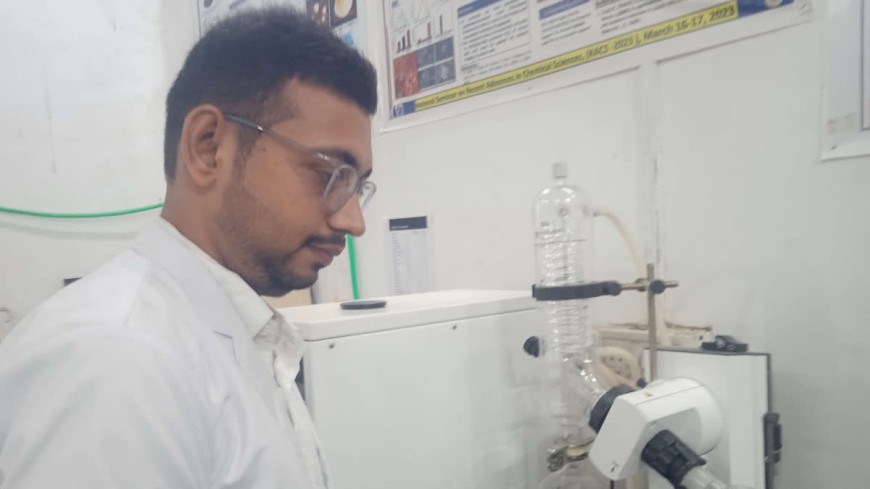
Sagar: A chemistry researcher at Dr Harisingh Gour University in Madhya Pradesh's Sagar has come up with an intervention that could revolutionize cancer treatment. Anand Kautu has been working on a method for cancer diagnosis based on liquid biopsy, which allows detection using a blood test alone. His research has been selected for a Sun Pharma Science Foundation Post-Doctoral Research Fellowship and he will now be working under Prof. S.G. Srivatsan at the Indian Institute of Science Education and Research (IISER) at Pune.
Currently, cancer is diagnosed through solid biopsy, which involves removing the cancerous tumour to diagnose the disease. This is a costly and painful procedure that normally detects cancer in its last stages.
At IISER Pune, Anand will work on developing an aptamer-based cancer detection technology with the aim of developing a sensitive and reliable system for detecting cancer-related signals in blood using liquid biopsy. “Liquid biopsy may provide a less invasive option in many situations compared to traditional tissue biopsy," said Anand.
This research may prove useful in the development of technologies that facilitate cancer detection in the future. Aptamers are short DNA or RNA sequences that are capable of recognizing specific biological targets. Through their chemical modification and use in suitable sensor systems, work will be done to improve the ability to detect cancer-related signals.
Anand completed his doctorate under K.B. Joshi, Assistant Professor in the University's Department of Chemistry. He worked on the development of small peptide-based nanostructures and their potential for the detection and mitigation of toxic heavy metals, particularly lead and cadmium.
His research has been published in international science journals such as ‘Chemistry – An Asian Journal’, ‘ChemMedChem’, ‘ChemBioChem’, ‘ACS Chemical Neuroscience’, ‘Chemical Communications (ChemComm)’, ‘Nanoscale’ and ‘Nanoscale Advances’.
Joshi's research focuses on organic synthesis, peptide and DNA-based self-assembly, nanotechnology, medicinal chemistry and chemical biology. His research group focuses on exploring solutions to health and environmental problems through biomolecules and nanostructures.
Joshi underlined, "Anand’s achievement is not only a significant milestone in his personal academic career but also a source of inspiration for the young researchers of Sagar University. It underlines the potential of research being conducted at the University and the expansion of young scientific talent emerging from here at the national level."
Anand has been selected for a Post-Doctoral Research Fellowship by the Sun Pharma Science Foundation that encourages scientific research, innovation and advancements in medical science by providing opportunities to young scientists. The Foundation's prestigious Post-Doctoral Research Fellowship is awarded to a maximum of 10 fellows.
The selection process for this fellowship is rigorous and competitive, with qualified Indian scientists from various institutions across the country competing based on their research potential, academic achievements and innovative research proposals. The final selection is made from among the most talented and outstanding scientists with strong research potential. The fellowship is for a period of three years and includes a monthly stipend of Rs 75,000 and an annual stipend of Rs 7.5 lakh for research-related contingencies.
The success of Anand of Chandpur in Sagar's Rahli tehsil is inspiring for young students and researchers. It demonstrates that through persistent hard work, quality research training and proper guidance, talented young people from small towns and humble backgrounds can also gain research opportunities at the country's leading scientific institutions.