Akka Review: When Women Rule, Is The World Really Any Different?

What happens when women rule the world? Do they rule differently or they simply become the men they once fought against?
Akka is set in the fictional land of Pernuru in South India. The five-episode series takes us into an 800-year-old matriarchal system through a non-liner screenplay. In this period crime thriller, power belongs to women and three powerful gharanas control the land. Their rules are clear and anyone who challenges them must be prepared for bloodshed.
Pernuru is introduced by the distinctively deep voice of Mahesh Manjrekar much before he appears on screen as Shankar Anna. The region is divided into three gharanas: Malemar (the House of Fields), Perplady (the House of Seas), and Herkada (the House of Mountains). "Akka" is the ultimate power and title given to the matriarch who rules the three gharanas.
At the heart of this system are three vows that every heir, Akka, must take. The gharana will be known by its matriarch. Marriage has no meaning. And dividing a gharana is forbidden.
The series opens in 1947. India has just gained independence. The government wants Pernuru to merge with the state. But matriarchs of the land are not ready to give up their centuries old rule. Ultimately, they negotiate terms with the government that allow them to continue managing their empire with minimal external interference.
In a passing shot we see women reading English newspapers in a third place. It is a small but important detail. Education has played a major role in keeping this society alive. The system looks traditional but its women are neither uneducated nor powerless.
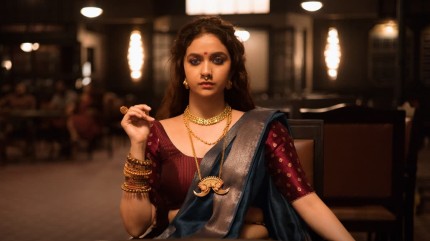
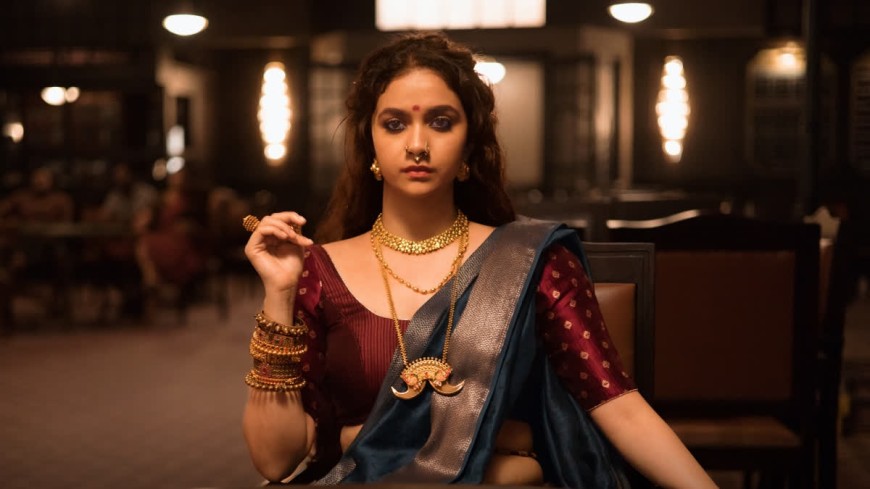
Bhavani (Keerthy Suresh) is one of the strongest women in this world. She believes in protecting the system at any cost. She can be ruthless. She can kill. But she sees it all as a duty towards her people and her tradition. At the same time, she is capable of recognising flaws within her own side and understanding that the Akkas can also be in the wrong.
This is quite a contrast to the warm, compassionate and empathetic Dorothy we saw Keerthy play in Karthik Subbaraj's film that released last month. Here, that warmth has given way to a commanding woman with tough demeanor.
The dynamic in Pernuru shifts dramatically with the arrival of Radhika Apte as Rudra. She proves to be a fitting nemesis to Keerthy's Bhavani.
She is a dangerous combination: a beautiful, heartless woman who is aware of her looks and uses it as a weapon. She is ruthless and burning with vengeance. Rudra believes Bhavani inherited her power, while she had to earn every bit of hers. Radhika brings a strong presence to the role and her confrontations with Keerthy keep the story moving forward.
Tanvi Azmi brings weight to Muthakka. She represents the older generation and the values on which Pernuru was built. However, her past missteps have now returned to haunt the present.
Pooja Mohanraj as Deju makes her presence felt as a strong warrior and royal guard who can kill and get killed for Pernuru. Her backstory adds another layer to the narrative.
But at the heart of Akka are Keerthy Suresh and Radhika Apte. Both actors bring different shades to their characters. Their rivalry gives the series its energy.
There is also a sharp line that sums up the attitude towards men in this world: "Mardon ka ahankar unki akal se bada hota hai." It is not that these women hate men. They simply don't believe they need men to run their lives or their world.
Marriage in Pernuru is not quite what we know it to be. Women have the right to love. But institution of marriage is not for them. Bhavani loves Nanda (Vishak Nair). But she cannot marry him. She wants a daughter with him, though. For her, being an Akka comes with responsibilities that leave little room for personal happiness.
In this world, a daughter is considered a woman's true companion. Birth of girl child is celebrated, something that is still not the case in many parts of our country. Adoption runs very naturally in the system. Muthakka (Tanvi Azmi) makes a powerful point about how loving an adopted child is a woman's real strength.
The series raises interesting questions about marriage, motherhood, inheritance and the price Pernuru's women pay to hold on to power. But it does not always explore these ideas deeply enough.
The canvas is large. Most characters come with a backstory. At times, it becomes difficult to keep track of all the connections. The characters themselves seem to be navigating an equally complicated web.
But is matriarchy really different? This is where Akka leaves us with mixed feelings.
For all its interesting ideas, the violence, revenge, betrayals and power struggles feel very familiar. Would anything have been different if Pernuru had been ruled by men? The bloodshed would probably have been the same. So would the greed, ego, manipulation and hunger for power.
At times, Akka feels like a revenge drama with women replacing men in every position. The gender seems interchangeable and that is a missed opportunity.
It would have been a far more fascinating to watch if the series had explored what makes a matriarchal society truly different. What are the unique strengths of such a system? How does it shape relationships? How does it approach leadership, motherhood, inheritance and conflict differently? The series touches upon these questions but rarely digs deep enough.
Dharmaraj Shetty deserves credit for attempting something this ambitious as his writing and directorial debut. Creating an entire fictional society with its own traditions, politics and power equations is no small task.
Sheetal Iqbal Sharma's costume design and Laxmi Keluskar's production design bring the key textures needed for a period crime drama.
Akka is an ambitious attempt at building a world where women hold all the power. It has strong performances, interesting characters and enough twists to keep the story moving.
The series ends on a cliffhanger leaving the possibility open for a second season.