US Midterm Elections: Why Is Trump Targeting Progressive Muslim Candidate Abdul El-Sayed?

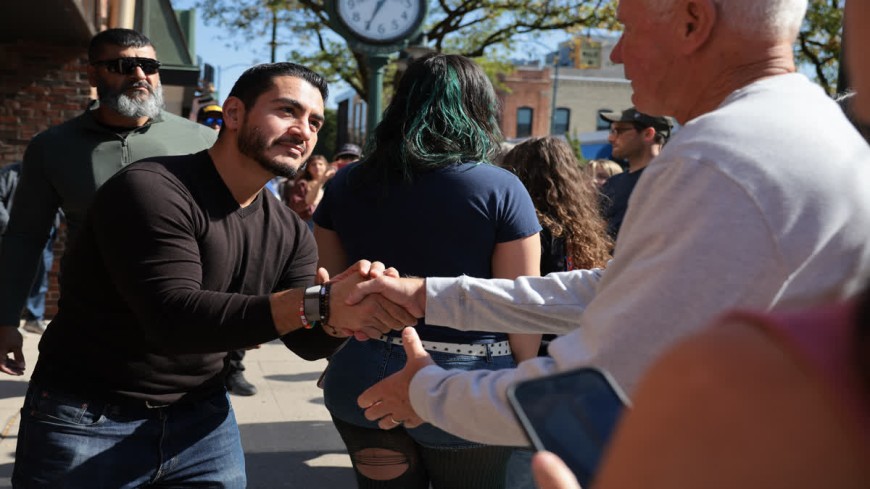
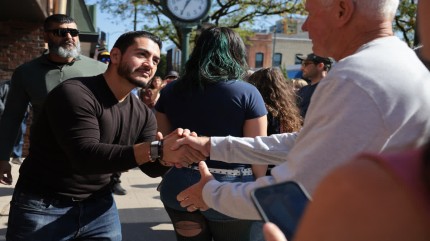
New Delhi: Abdul El-Sayed, the Democratic Senate candidate for Michigan in the November 3 mid-term election, faces the ethnic, religious minefield that all non-Caucasian American politicians face.
El-Sayed was born in Michigan in 1984 to Egyptian immigrant parents, and when he was three his parents divorced. His father and a white stepmother raised him. El-Sayed became an accomplished public health expert and served in Wayne County after earning a doctoral degree at Columbia University.
He is among hundreds of candidates fighting for a place in the US Congress in these midterm elections for 435 House of Representative and 35 Senate seats. But no one has quite grabbed as much attention as El-Sayed, a progressive Muslim candidate, who has become a key target for the Republican Party. Trump has mocked his name in an effort to polarise voters in support of the Republican nominee, former US Representative Mike Rogers.
While US President Barack Obama has endorsed his candidature, there are division even within the Democratic Party over his campaign. He belongs to a new group of young Democrats of a multi-ethnic America, who are proud of their immigrant parents and unapologetic about their immigrant roots.
Nothing illustrates this better than in the manner in which he has handled allegations thrown against him about having links to the Muslim Brotherhood, an outlawed Islamist group. The US has banned chapters of the group as terrorist organisations.
In November 2012, Abdul El-Sayed co-signed a statement in support of the popularly elected president of Egypt, Mohamed Morsi, from the outlawed Islamist group Muslim Brotherhood, seeking exemption of his actions from judicial review, calling for purges of the media and police, and rejecting Western interference in Egypt.
Morsi was overthrown in 2013 by the army under Abdel Fattah el-Sisi. Branches of the group have been designated by the US as foreign terrorist organisation. El-Sayed's position has been that it was not right to replace a democratically-elected president. This position has come to haunt him in the 2026 midterm elections.
Most Republicans portray El-Sayed’s candidacy as risk-laden because he is a Muslim, with President Donald Trump in his intemperate and unbridled invective has labelled El-Sayed a “Muslim Brotherhood guy, 100%” even though there is no evidence to back the claim.
El-Sayed has taken the challenge head-on and is refusing to be baited. He is keeping the focus on high fuel and grocery prices apart from access to health, and he has used the Iran conflict to criticise US President Donald Trump, drawing a link to how that has led to an increase in prices of fuel and groceries.
He has also countered the Republican campaign to paint him as a supporter of the Muslim Brotherhood. He has highlighted how his commitment is to the US Constitution, which allows each individual to practice his or her own faith, and pray accordingly.
"I'm not running to be a Muslim senator. I'm running for the U.S. Senate and happen to be Muslim", he said referencing a famous quote by for US President John F. Kennedy. Kennedy in his response's response regarding his Catholicism. John F. Kennedy in his 1960 presidential campaign addressed concerns about his religion saying he is a Democratic Party's candidate for president, "who happens also to be a Catholic."
El-Sayed refuses to be apologetic about being a Muslim or an ethnic Egyptian. And he takes this stand without getting angry, or raising his voice, but with a firm tone, refusing to be browbeaten by insidious accusations.
And he confronts those raising the question whether he disavows his support for the Muslim Brotherhood by saying that they are asking him this question because he is a Muslim and an Egyptian, and the question exposes their ingrained prejudice against non-whites.
In an interview, El-Sayed’s sister said that her family supported the Muslim Brotherhood, and that their mother worked for the organisation. El-Sayed said that he had no connection with the Muslim Brotherhood, as his mother left him after his parents divorced when he was three. On October 18, he highlighted that he had condemned the Muslim Brotherhood.
It was also found that his mother had worked for a voluntary organisation that sent aid to the Muslim Brotherhood, and investigations found that El-Sayed’s mother, a nurse, was not guilty of any wrongdoing.
But Republican candidate Mike Rogers has continued to argue that El-Sayed had not adequately disavowed the organisation.
Liberal commentators, including language philosopher Grace Patterson, pointed out that the word ‘disavow’ is a trap. It would mean that a person had connections with the Muslim Brotherhood and Islamic extremism, and he is now breaking away from it. Paterson explained, “There’s a lot more implicit in the disavowal question. You can condemn things you just learned about. Disavowal brings in, I think, this implicit content that there’s a significant connection between the person and the thing.”
El-Sayed takes the position that he is a proud and loyal American as well as a Muslim and an Egyptian-origin person. He is taking up the position that he wears his multi-dimensional identity openly and boldly. El-Sayed does not belong to the emerging radical left among the Democrats. He is a progressive Democrat who has criticised America’s alliance with Israel as counter-productive, which has dragged America into an unwanted war against Iran.
Most Democrats, even more than Republicans, are unqualified supporters of Israel. But young Democrats no longer toe the orthodox party line. And they are supported in their new anti-Israel stance by liberal Jewish Americans. His campaign promises include universal healthcare, higher education without the debt trap and restricting corporate influence in politics.
El-Sayed ran the Michigan governor’s race in 2018 and lost, and he won the Democratic primary for the Senate candidacy against Democrat Congressman Haley Stevens, who is an Israel supporter like many Democrats. And El-Sayed faces a tough contest with Republican rival Mike Rogers.
El-Sayed brings a new kind of cool to American politics at a time when Trump and his Republican supporters have been trying to polarise the political arena. He is refusing to downplay his Muslim identity in the face of a negative campaign against his religious identity. And he is staying within the guardrails of the United States Constitution to claim his religious identity and his participation in American politics as a rightful citizen of the country.
There is desperation in Trump’s belligerence because he seems to realise that American voters would not be distracted by his right-wing rhetoric which singles out Muslims, Arabs and Africans as the cause of America’s woes.
What is pinching ordinary Americans are the high diesel prices, which result from America’s war with Iran. El-Sayed senses the real causes of America’s economic stress, and is holding his ground with unruffled determination.