Solar Eruptions Are Lopsided Chaos: How Aditya-L1's VELC Payload Revealed The Secret In 3D

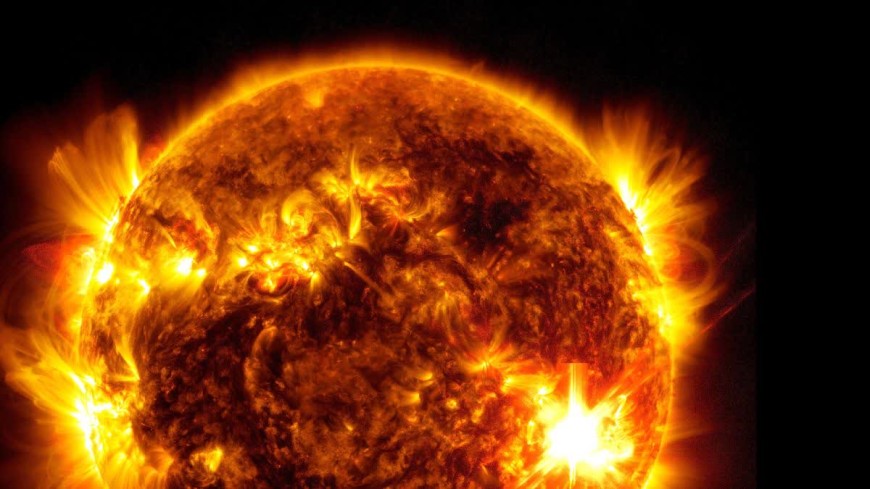
Bengaluru: A solar eruption does not always expand evenly like a bubble. New observations from India's Aditya-L1 mission show that a coronal mass ejection (CME), a massive burst of plasma from the Sun, can expand unevenly and take on an asymmetric shape. The findings, published in The Astrophysical Journal Letters, could help scientists better understand how solar eruptions travel through space and influence space weather.
VELC: A new way to study solar eruptions
Launched in September 2023, Aditya-L1 is India's first space-based solar observatory. It operates at the Sun–Earth L1 point, allowing it to observe the Sun continuously. The spacecraft carries seven scientific instruments, including the Visible Emission Line Coronagraph (VELC), its primary payload.
Designed and fabricated by the Indian Institute of Astrophysics (IIA) at its MGK Menon Laboratory for Space Sciences at the CREST campus in Hosakote (with substantial support from ISRO), VELC offers a unique capability to study solar eruptions close to the Sun. It is an internally occulted coronagraph, designed to block the bright solar disc and observe the much fainter corona, the Sun's outer atmosphere.
"Unlike conventional images, which show how a CME moves across the sky, VELC's spectroscopic observations can also measure the movement of plasma towards or away from the observer along the line of sight. This provides a more complete picture of the eruption's three-dimensional motion," Saurabh Tripathi, a PhD student at IIA and lead author of the study.
Jayant Joshi, a co-author of the study, said that by combining VELC's observations with data from other instruments and 3D modelling, the researchers reconstructed the CME's shape and different aspects of its motion. Their model showed that an inclined CME structure with uneven sideways expansion could explain VELC's unusual spectral observations, whereas a uniformly expanding model could not.
VELC is currently the only operational space-based coronagraph that regularly provides spectroscopic observations of the solar corona beyond the Sun's visible edge. "This capability allows scientists to study the three-dimensional structure and movement of CMEs during their early stages, improving our understanding of how they evolve and travel through space, potentially affecting Earth and its space-based infrastructure," said Tanmoy Samanta, a solar astronomer at IIA and the corresponding author of the study.
How VELC captured the eruption's movement
The instrument observes the solar corona through a green emission line at a wavelength of 530.3 nanometres, produced by highly ionised iron atoms in the corona. This emission captures hot plasma at temperatures of around 1.8 million kelvin. By measuring small changes in the wavelength, known as the Doppler shift, scientists can determine how the plasma is moving. The observations revealed distinct blue-shifted and red-shifted signals.
He said that an asymmetrically expanding CME may interact differently with the surrounding solar wind, affecting its speed and direction. Understanding its three-dimensional structure and motion could therefore help scientists improve models of how CMEs propagate through space.
"Predicting when a CME will reach Earth and how it will evolve along the way remains challenging," he added. "The study offers a new way to understand changes in a CME during its early stages. Incorporating such observations into future models could help improve predictions of a CME's speed, direction and arrival time at Earth."
What Asymmetric Solar Eruptions Mean for Earth
When a CME is directed towards Earth, Samanta explained that it can trigger geomagnetic storms, disrupt satellite operations and radio communications, and pose risks to power grids. "Predicting a CME’s speed and trajectory is therefore important for assessing its potential impact on Earth. This requires a better understanding of how the eruption evolves in three dimensions near the Sun," he added.
However, the present study does not directly establish whether or how asymmetric expansion influences the severity of geomagnetic disturbances. Further research is needed to understand how these eruptions propagate through space and interact with Earth’s magnetic environment.
Reconstructing CME Motion, Advancing Space-Weather Research and Improving Forecast Preparedness
Traditionally, reconstructing a CME's three-dimensional structure has relied on observations from multiple spacecraft viewing the eruption from different directions. VELC offers a complementary approach by combining spectroscopic measurements of plasma motion along the line of sight with imaging observations from a single vantage point.
According to the study, this could help scientists reconstruct CME motion without depending entirely on multiple spacecraft, particularly in the lower corona, where eruptions evolve rapidly, and their movement (towards or away from the observer) cannot be determined through imaging alone.
The next step is to apply this technique to more CMEs observed by Aditya-L1, particularly those originating near the solar limb, to study their three-dimensional structure and expansion during the early stages. In the longer term, this could improve CME propagation models and contribute to better space-weather forecasting.