Explained: How Shrinking Antarctic Sea Ice Is Making Deep Ocean Waters Saltier & Reshaping Global Ocean Circulation

Bengaluru: A sharp decline in Antarctic sea ice since 2015 has led to an increase in the salinity of Antarctic Intermediate Water (AAIW), according to a new study published in Nature Climate Change. The change in the major ocean water mass could affect ocean structure and circulation, with implications extending far beyond the polar region.
For decades, AAIW had been becoming fresher. However, after 2015, this long-running trend appears to have reversed. Researchers from the Indian Institute of Science (IISc), the University of Melbourne, and the University of Southampton investigated the link between sea ice loss and changes in this important water mass.
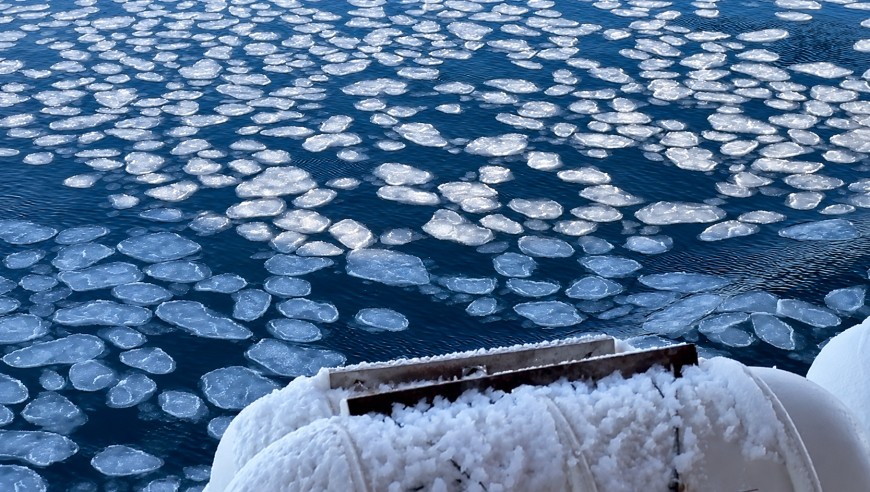
Every year, during Antarctica's winter between May and July, sea ice forms across the Southern Ocean. As temperatures rise, much of it melts, releasing freshwater into the ocean. This seasonal cycle helps shape the properties of AAIW, which forms in the Southern Ocean and spreads northwards through the Atlantic, Indian, and Pacific oceans at depths of hundreds of metres.
Changes in salinity (the amount of dissolved salt) can affect stratification, or how ocean water layers. This layering affects how easily different water masses mix and how heat, carbon, and nutrients move through the ocean.
What makes this study significant?
Explaining the significance of the change, Bishakhdatta Gayen, corresponding author of the study and associate professor at the Centre for Atmospheric and Oceanic Sciences (CAOS), IISc, told ETV Bharat that differences in water density determine how easily different ocean layers mix and influence circulation. However, denser water does not automatically mean stronger circulation. Freshwater supply and the processes involved in forming and moving the water mass also play a role.
Changes in circulation could affect how much carbon the ocean stores, as ocean currents carry carbon from the surface into deeper waters and can also bring carbon-rich water back towards the atmosphere. The extent of this impact needs further investigation.
Earlier studies had documented AAIW's long-term freshening and the role of Antarctic sea ice in shaping its properties. This study provides evidence of a reversal and traces the changes from sea ice through the source waters into AAIW, Prof. Gayen said.
“What surprised us was the speed: a trend that had persisted for decades reversed within a few years. Our study shows that Antarctic sea ice loss is reorganising waters far beneath the surface, not simply changing the ice cover we see from space,” added Prof. Gayen. Kaushik Mishra, the study's lead author and a PhD student at CAOS, IISc, said, “Changes to this water mass can carry the effects of changes near Antarctica far beyond the polar region.”
How sea ice loss changes ocean waters
The researchers linked the reversal in AAIW's salinity to reduced freshwater from melting sea ice and an increased upward movement of warmer, saltier water from the ocean's depths. Freshwater from melting sea ice helps maintain a relatively fresh layer of cold water near the surface. This water contributes to the formation of AAIW as it moves northwards. The cold layer that develops during the Antarctic winter, known as Winter Water, is important to this process.
Prof. Gayen explained that sea ice acts as a seasonal freshwater transporter. When seawater freezes, most of its salt remains in the ocean. Winds and currents carry the ice away from where it forms, releasing freshwater when it melts. With less sea ice, less freshwater reaches these regions, making the water saltier and, other things being equal, denser. Below the surface lies warmer, saltier water known as Circumpolar Deep Water. A fresh surface layer normally limits its mixing with deeper water. When this layering weakens, more salt and heat can reach the upper ocean, making it harder for sea ice to grow.
"This can create a cycle in which reduced ice cover allows more heat from below to reach the surface, further limiting ice growth. These changes can then influence the waters that contribute to AAIW," Gayen said. "Since AAIW connects the Southern Ocean with the intermediate depths of the Atlantic, Indian, and Pacific oceans, changes in the waters where it forms can spread far beyond Antarctica. If the trends persist, they could affect how heat and other substances are transported and stored in distant ocean regions over years to decades. However, the impact will depend on ocean pathways, mixing and timescales."
"Continued monitoring will be essential to determine whether this reversal persists, intensifies or eventually eases. Long-term observations will help scientists assess how changes in Antarctic sea ice are affecting the wider ocean," he added.
What other factors contribute to the increase in salinity?
Prof. Gayen said reduced freshwater supply from sea ice melt was the primary driver of the increase in salinity in the AAIW source region. The study found that changes in source-water properties accounted for about 95 per cent of the salinity increase in its diagnostic analysis. Other factors, including upwelling, mixing, winds, ocean heat exchange, precipitation, and interactions with neighbouring water masses, also influence these waters.
Precipitation increased during this period, which would normally make the ocean fresher. It therefore cannot explain the observed increase in salinity, he added.
Why these Antarctic changes matter for India
India's connection to the wider Indian Ocean makes these findings relevant. The ocean influences climate, supports marine ecosystems and sustains coastal livelihoods. Prof. Gayen said that understanding changes reaching the Indian Ocean from the south is important for tracking its long-term evolution. Changes in ocean circulation and layering can affect the distribution of heat, oxygen, carbon dioxide and nutrients, with implications for climate and marine life. However, this study does not establish a direct impact on the Indian monsoon, fish catches, or specific coastal communities.
Adding further, he said that previous studies have suggested a link between variations in AAIW and the Indian monsoon. Whether the current changes in this water mass will influence future monsoon rainfall remains to be investigated. The observations can help scientists test and refine climate predictions and, alongside regional research, support better-informed planning for fisheries, coastal management and climate adaptation. This is a contribution to long-term preparedness, not an immediate local forecast.
How did the researchers track the changes?
Explaining how the team compared different datasets, Prof. Gayen said, “We compared three established ocean datasets, EN4, IAP, and RG-ARGO, based largely on measurements from robotic Argo floats, which record temperature and salinity in the upper ocean. We tracked AAIW using its distinctive low-salinity layer and examined the colder Winter Water that feeds it. We also analysed changes in density and depth, tested trends for statistical significance, and assessed uncertainties and data coverage.”
Since the datasets share many underlying observations, their agreement shows that the findings are robust across different processing methods, rather than being based on three independent observing systems.
“To investigate the mechanism, we combined satellite observations of sea ice with ocean–ice reanalysis. We estimated freshwater transport using sea ice concentration, thickness, and drift, and calculated the salt budget in the source region,” he added.
Regional differences in salinity changes
The researchers also found that the increase in salinity was not uniform across the Southern Ocean. Asked about the regions where the changes were greater, Prof. Gayen said even small changes in salinity can affect ocean circulation across vast volumes of water. The main finding is that the earlier trend has reversed across a widespread water mass, accompanied by changes in density and depth.
This is the rate of change per decade, not the total increase over ten years. Changes were particularly pronounced in the South Atlantic, where local salinity increases immediately north of the Polar Front exceeded 0.1 grams per kilogram per decade.
The researchers found a consistent shift towards saltier, denser, and deeper water across three ocean datasets. The findings show that changes in Antarctic sea ice extend well below the ocean surface, affecting a major water mass with links to the Atlantic, Indian, and Pacific oceans.
"The speed of these changes is a powerful reminder that even the deep ocean is responding to a rapidly warming planet. What happens around Antarctica does not stay in Antarctica. Urgent and sustained action to reduce greenhouse gas emissions is crucial to limiting further disruption to the global ocean and climate system," noted Prof. Gayen.