
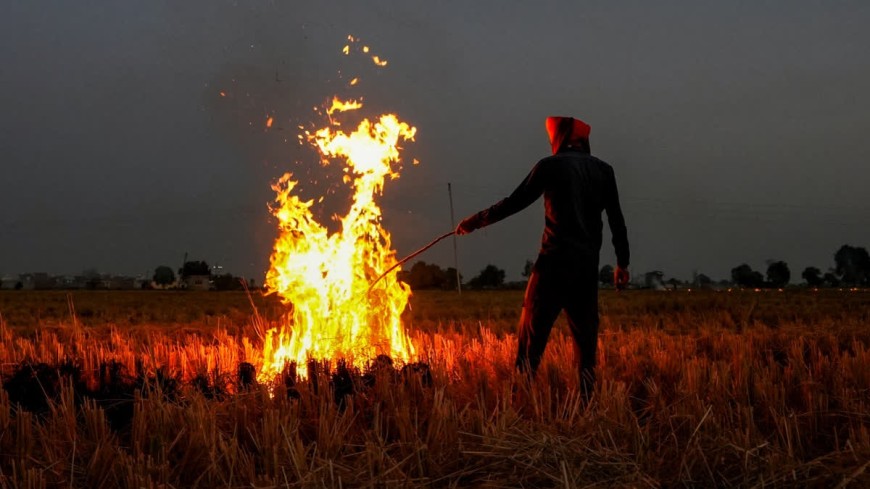
India saw its worst ecological Diwali so far. Media reports point to the air quality index (AQI) going over 3000, making Delhi-NCR comparable to the Chernobyl disaster. But even in the following days, official figures are above 300. Stubble fires in Punjab have also increased as the paddy crop is being harvested, and the emissions from industries and vehicles continue to deposit toxic soot in our lungs. So where does one go to breathe? Where does one look for solutions?
A study published by the Indian Institute for Tropical Meteorology (IITM), Pune, pointed out that firecrackers contributed to 71% of Delhi pollution on Diwali night, followed by secondary organic aerosols at 17.5%, vehicular emissions at 11.7%, secondary inorganic aerosols at 11.7%, wood and biomass burning combined at 14%, Waste burning at 7.7% and mineral dust and ash at 1.5%.
This report suggests that the various schemes and programs that our government has spent over Rs 16,000 crores on in the last 11 years have failed to deliver the intended results. Industries continue polluting, vehicles emit toxic smoke, our rivers are frothing and the farm fires keep burning. Meanwhile, reports and studies keep piling up on how toxic the air has become. A recent report pointed to two million deaths in India from air pollution and costs India 9.5% of its GDP in 2023.
Not to forget that millions each year suffer numerous respiratory ailments, newborns have congenital defects and the poorer Indians are robbed of their right to clean air. Political parties don’t stop trading blame; meanwhile, we all suffer.
So what can be the way out?
The first step is to begin an anti-corruption drive within the government because both the state and central governments have excellent plans and programs on paper, but somehow they fail to curb pollution. Rs 16,000 crore is a big sum; in a joint effort, the vigilance commissioner and the auditor general of India should look into how the money was utilised. Meaning, whether the projects and programs to curb various aspects of the pollution were implemented. We need a white paper on this subject, followed by a joint Parliamentary Committee to review this matter.
The next step is obviously to punish the guilty of corruption and ecological degradation in the region. Recently, the Union Environment Minister asked for Secretary-level bureaucrats to lead teams to curb pollution across states. Alongside this, they were directed to raid polluting industries, enforce strict vehicular checks and bring to task “non-performing officers”.
The central and state pollution control boards were reprimanded, but the question is, why so late? Isn’t India supposed to have air quality standards all the time? So although the moves are welcomed, they come a little late. We have another toxic winter ahead.
Now, if the government wants to change this next year, we have to start at the ground and strictly enforce our pollution regulations and arm the state and central pollution control boards with enough muscle to stop pollution. If industries in India follow government rules, without corrupting the process or officers, it will solve half the problem.
But in another major task, we must move towards Punjab and Haryana, where farmers are forced to burn the stubble of paddy fields. The farmers lack the time, stubble management machinery and financial incentives to stop stubble burning. Despite thousands of crores and the push for stubble as raw material for allied industries, farmers get no price or value for stubble and hence are goaded to burn it.
So we must begin with the farmers; the government and FCI need to change their procurement and Minimum Support Price (MSP) policy. Rice or paddy procurement from Punjab and Haryana should be replaced with different crops suited to the region’s agro-climate.
A deep crisis of water, migration and labour shortage plagues both states. To battle these challenges and resolve the stubble burning issue, the government should promote oilseeds, legumes, other cash crops or agroforestry. On the other hand, farmers may find it difficult to switch to oilseeds or legumes; hence, the government should at least ensure guaranteed procurement backed by financial bonuses. This way, farmers won't suffer, and the paddy stubble burning problem will also disappear.
The government needs to slowly stop procuring paddy from Punjab and Haryana and instead move to rice bowls of India like Uttar Pradesh, Chhattisgarh, Bihar, Assam, etc for paddy procurement. This way, we can conserve our water and also improve incomes for farmers in these areas.
Bio-regional agricultural clusters should be created in Punjab-Haryana so that farmers can be supported to shift towards ecological agriculture and agro-forestry. Even along the major highways, especially around the Delhi-NCR region, the government can grow bamboo and other fast-growing trees, so the emissions from the roads can be absorbed closer to the source. Farmers should be enrolled in agro-forestry programs alongside the roads.
The carbon credit market can raise more money for the agro-forestry clusters and also supplement farmers' incomes. NHAI and the Environment Ministry need to work together for more plantations. Stricter penalties should also be implemented for illegal deforestation and the timber mafia.
The Punjab and Haryana governments should also develop carbon sinks such as wetlands to reduce pollution.
We have to move away from the current paddy policy and reorient ourselves towards heirloom seeds and ecology to end the stubble burning problem. India also needs to innovate by bringing newer machines, from deep-cut harvesters to more mechanical tools and machines for harvesting oilseeds, legumes and millets, which will make farming these crops easier.
On the city side, we need to limit the number of cars in Delhi and also have protocols for AQI emergency lockdowns.