
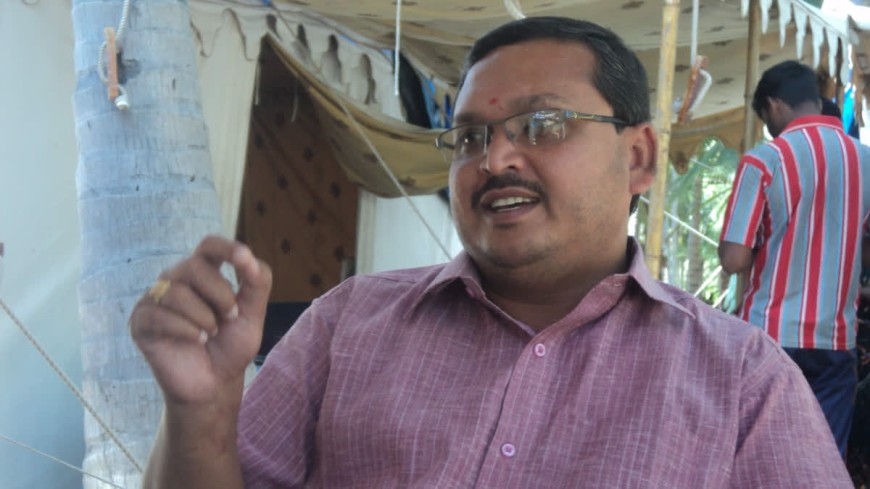
Madurai: The Archaeological Survey of India (ASI) has reportedly denied permission to archaeologist K Amarnath Ramakrishna, who led the first two phases of excavations at Keezhadi, near Madurai in Tamil Nadu, to attend an international Tamil historical research conference in Malaysia next month. The development has triggered controversy amid the continuing differences between the archaeologist and the ASI over his excavation report.
Amarnath Ramakrishna had sought permission to attend the Tamil Historical Research Conference scheduled to be held in Kuala Lumpur on December 19 and 20. However, the ASI reportedly made its clearance conditional on his accepting certain restrictions on his participation and agreeing to submit a record of his speech after returning to India.
According to reports, the ASI asked Amarnath Ramakrishna to submit both a written copy and a video recording of his conference presentation after his return. He was also reportedly asked not to express views contrary to the official positions and policies of the ASI or the Union government.
The conditions further required him to give an undertaking that he would not make comments critical of the activities, policies or reputation of the ASI and the Central government.
A letter from the Director of the ASI's Administrative Division reportedly stated that the required No Objection Certificate (NOC) under the Foreign Contribution Regulation Act (FCRA) would be issued once he accepted the conditions and submitted the undertaking.
Amarnath Ramakrishna declined to give the undertaking. Consequently, permission for his proposed visit to Malaysia was not granted.
He had also reportedly been denied permission to attend a conference in the United States in July. The latest development marks the second occasion on which his participation in an overseas academic event has been blocked, raising questions about the conditions imposed on government archaeologists attending international conferences.
Dispute Over 982-Page Report
Amarnath Ramakrishna led the first two phases of excavations at Keezhadi in Sivaganga district between 2014 and 2016. The excavations brought to light evidence of an ancient settlement, including brick structures, drainage systems, covered wells, pottery and beads, offering insights into the region's urban life and material culture.
He prepared a 982-page report on the findings from the 2014-15 and 2015-16 excavation seasons and submitted it to the ASI in January 2023.
The report suggested that the early phase of the Keezhadi settlement could date from the eighth century BC to the third century AD. The ASI, however, raised objections to aspects of the chronology and classification of the excavated materials.
It reportedly sought additional scientific evidence and clearer explanations to support the proposed dating, particularly for the period between the eighth and fifth centuries BC. ASI also sought more precise descriptions of the archaeological layers and the dating of individual artefacts, recommending revisions based on the observations of two experts.
Amarnath Ramakrishna maintained that his conclusions were based on stratigraphy, cultural characteristics, artefact analysis and scientific dating through Accelerator Mass Spectrometry (AMS). He reportedly rejected the proposed changes, arguing that the report contained the necessary supporting material and chronological explanations.
5-Member Panel Examines Report
The ASI subsequently constituted a five-member committee to examine the 982-page report. Its assessment, reportedly submitted in December 2025, ran to 114 pages and pointed out areas where the findings were considered unclear or insufficiently explained.
In his response to the ASI in February 2026, Amarnath Ramakrishna reiterated that his findings followed established archaeological procedures and called for the report to be published without alterations.
The disagreement over the report has remained unresolved, with the archaeologist maintaining his conclusions and the ASI seeking further clarification and supporting evidence.
Meanwhile, scientific dating of materials recovered during subsequent excavations by the Tamil Nadu Archaeology Department has placed the beginnings of the Keezhadi settlement at around 580 BC, suggesting an antiquity of approximately 2,600 years.
The findings have added to the debate over the chronology of the settlement and the dating proposed in Amarnath Ramakrishna's report.
Subsequent excavations at Keezhadi have yielded more than 13,000 artefacts, according to reports. These include pottery, beads, brick structures, drainage systems and other material remains that have helped researchers study the settlement's urban features and cultural practices.
KL Meet Becomes A Fresh Flashpoint.
The denial of permission for Ramakrishna to attend the Kuala Lumpur conference has brought renewed attention to the prolonged disagreement over the Keezhadi report.
The conditions reportedly imposed by the ASI have also prompted questions about the freedom of government-employed researchers to present their findings at international academic forums. The controversy comes as the publication of Ramakrishna's excavation report remains pending.