
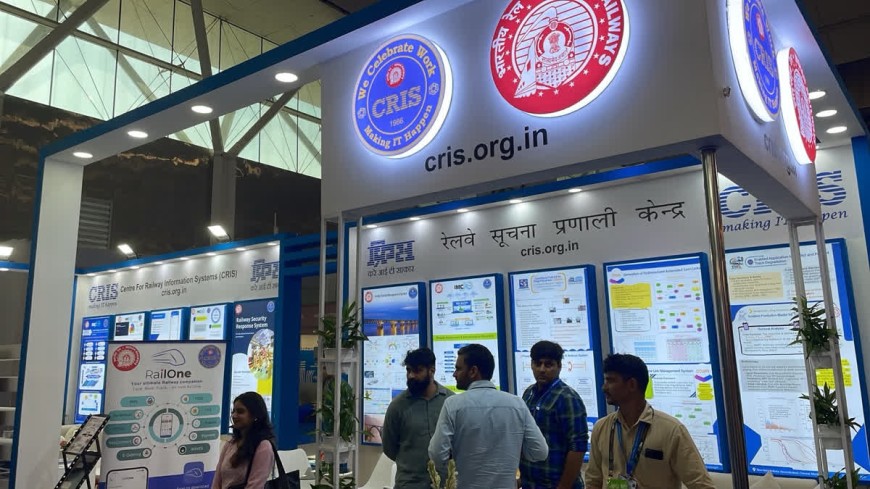
New Delhi: Indian Railways is upgrading its digital infrastructure and deploying artificial intelligence (AI)-based tools to improve passenger safety, grievance redressal and onboard cleanliness, while expanding the capacity of its ticketing system fivefold to handle 1.25 lakh tickets per minute.
The initiatives showcased by the Centre for Railway Information Systems (CRIS) include AI-enabled upgrades to RailMadad, an integrated crowd management solution, the Coach Mitra app for onboard housekeeping and the Railway Security Response System. The railway technology arm is also upgrading its passenger information system, with more than 1,100 of the approximately 4,000 trains covered under the migration programme already upgraded.
“Our passenger information system, which was originally designed in around 1995, is now being upgraded using 21st-century technologies. The existing system can process approximately 25,000 tickets per minute, and we are increasing its capacity fivefold to 1,25,000 tickets per minute. This will significantly improve passenger convenience and reduce ticketing failures,” Dilip Kumar Jain, principal project engineer at CRIS, told ETV Bharat.
“We are using cutting-edge technologies available in the market for this upgrade. Of the approximately 4,000 trains covered under the migration programme, more than 1,100 have already been upgraded. We expect to complete the entire migration by the end of this year,” he said.
AI model to predict station crowds, alert RPF
CRIS has developed an integrated crowd management solution that uses historical passenger data, current bookings and machine-learning models to estimate passenger volumes at railway stations and platforms. The estimates are intended to help the Railway Protection Force (RPF) plan staff deployment and manage crowds, particularly during periods of heavy passenger movement.
The system maps reserved passengers against actual train-running status and estimates unreserved passenger numbers using historical patterns. It combines station-wise and hourly data from the previous two years to calculate expected platform crowds and generates estimates for journeys over the next 60 days.
Reserved passenger projections are based on bookings available up to the date of calculation, while unreserved passenger volumes are extrapolated from previous-year data.
“This is an AI-powered crowd management solution. It predicts the number of passengers expected at a particular station, on a specific date and platform. If there is a sudden increase in passenger numbers on any platform, the system can alert RPF personnel, enabling them to deploy additional staff to manage passenger movement and prevent stampedes,” Jain said.
The display identifies New Delhi, Kolkata, Secunderabad, Chennai and Mumbai among the locations associated with the crowd management solution.
RailMadad to use AI to prioritise grievances
Railways is also showcasing AI-enabled capabilities for RailMadad, its passenger grievance redressal platform. Natural language processing (NLP) can help classify complaints according to their nature and urgency, while voice-to-text technology supports transcription in 13 languages, according to the CRIS display.
Planned capabilities include analysing images, audio and videos, identifying safety-critical complaints through predictive and sentiment analysis, and deploying virtual assistants across mobile applications, kiosks and station systems. Helpline 139 is also listed for round-the-clock AI-assisted passenger interaction.
The proposed features are intended to help railway authorities identify urgent complaints, track grievances through unique reference numbers and route them to the relevant field units. The displays also outline a future unified RailOne super-app experience to bring passenger services together on a single digital platform.
Meri Saheli, Rail Prahari to support railway security
The Railway Security Response System showcased by CRIS includes the Meri Saheli initiative, train escorting, a central dashboard, the Rail Prahari mobile application and a helpdesk.
Meri Saheli focuses on the safety of women passengers, particularly those travelling alone. Under the initiative, female RPF personnel can proactively interact with women passengers during their journey and check whether they require assistance, including senior women passengers who may need additional support.
“This is the RPF initiative designed to help female passengers travelling alone, particularly at night. Female RPF personnel can proactively check whether women travelling alone are safe and whether they require any assistance. They can also extend support to senior female citizens who may need help during their journey,” Jain said.
The Rail Prahari application provides security personnel with access to functions such as control-room contacts, jurisdiction-related information, duty management, station information, railway laws and circulars, and helpdesk services.
Coach Mitra app to monitor onboard cleanliness
The AI-enabled Onboard Housekeeping Services (OBHS) system uses the Coach Mitra app to monitor housekeeping staff deployment, attendance and cleaning activities in railway coaches.
The workflow includes train nomination, staff deployment, attendance monitoring, cleaning, photographs after cleaning, AI-based cleanliness assessment, result comparison and reporting. The system also uses QR-based coach access, geo-tagged attendance and time-stamped photographs for inspection and verification, according to the display.
The initiative aims to improve transparency and accountability in housekeeping operations by giving railway officials real-time visibility into staff attendance and cleaning activities. Future plans listed by CRIS include a centralised OBHS dashboard and AI evaluation metrics.