
Bengaluru: Galaxies contain much more than the stars we can see. Far beyond a galaxy's visible parts lies a huge, extremely faint reservoir of gas called the circumgalactic medium (CGM). It can extend 10–20 times farther than the galaxy itself and acts as a reservoir of material that can eventually fuel the birth of new stars.
This raises an important question: If so much gas is available around galaxies, why don't galaxies keep producing enormous numbers of stars?
If all the gas within the CGM cooled and collapsed to form stars, we would see many more extremely large and luminous galaxies than we actually do. For more than a decade, astronomers have suspected that supermassive black holes (SMBHs) at the centres of galaxies may help prevent surrounding gas from cooling and forming stars. But how a black hole, occupying a region that may be only about the size of our Solar System, can influence a galaxy containing hundreds of billions of stars has remained unclear.
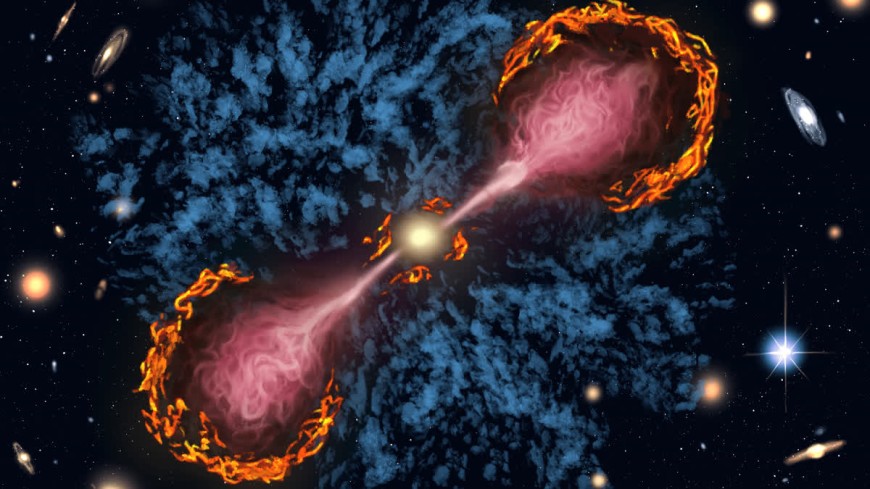
While black holes are known for pulling in surrounding matter, they can also shoot out jets of extremely hot, energetic, charged particles and plasma. But can the jets change the behaviour of the gas around them?
How black holes influence gas far beyond the galaxies
A new study led by Namrata Roy, Assistant Professor in the Astronomy and Astrophysics Division at the Raman Research Institute (RRI), provides observational evidence for one possible mechanism.
“We studied 324 galaxies whose central black holes shoot out powerful jets of hot, fast-moving plasma. We looked for a faint red glow from ionised hydrogen gas in their CGM. We found that this gas glows about 100 times brighter than in similar galaxies without such jets, especially along the path of the jets. This suggests that the jets compress, heat and ionise the surrounding gas. When the gas stays hot and energised, it will not cool and fall back into the galaxy as easily, potentially reducing the gas available to form new stars,” .
Roy and colleagues from India and the US wanted to know whether these jets could influence gas much farther away, in the galaxy's CGM.
The CGM is extremely faint and tenuous, making it difficult to study around an individual galaxy. The researchers therefore combined observations from many galaxies using data from the Dark Energy Spectroscopic Instrument (DESI) to identify the faint signal. When they averaged the observations in all directions around the galaxies, they did not detect a clear signal. But when they specifically examined the gas along the direction of the black-hole jet, a strong signal emerged.
Explaining this, Roy said, “When we averaged the gas around the galaxies in all directions, the signal disappeared. It was visible only along the direction of the jets, showing that their effect is confined to a narrow region. In simple terms, the jet appears to behave less like a lamp illuminating the gas in all directions and more like a powerful beam or torch, energising the gas along its path. Averaging in other directions therefore washes out the signal. Earlier studies may have missed this because they assumed the CGM was similar in all directions.”
Where the jet meets the gas
The researchers found the strongest signal at two locations: near the edge of the galaxy's stellar disk, where the jet first encounters the CGM, and again near the outer boundary of the CGM, where the slowing jet interacts with the surrounding gas and deposits energy.
Roy said, “The first region is just outside the main body of the galaxy, where the young jet leaves the inner region of the denser galactic gas and encounters the CGM. The second is farther out, near the end of the jet, where it slows, spreads into large bubbles called radio lobes and deposits energy into the surrounding gas. The weaker glow between these regions suggests that the jet's impact varies along its path.”
The researchers also examined a tracer of cooler gas. This gas was distributed much more uniformly in different directions rather than following the jet. This suggests that the black-hole jet is not affecting the entire CGM equally, but is having a particularly strong effect on the gas lying in its path. This difference could have consequences for star formation.