
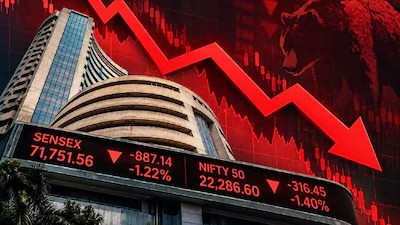
Why Is Share Market Falling Today, October 8? Indian stock markets witnessed a sharp sell-off on Thursday, October 8, with benchmark indices extending losses for the second straight session as investors reacted to the Reserve Bank of India's (RBI) hawkish policy stance, rising crude oil prices, a weakening rupee and continued foreign fund outflows.
As of 1:55 pm, BSE Sensex was down 1,068.14 points, or 1.49%, at 71,559.65. The 30-share index opened at 72,668 and touched an intraday high of 72,693.97 before plunging to a low of 71,550.76.
The NSE Nifty was trading at 22,241.40, down 362.20 points, or 1.60%. The index had opened at 22,599.05 and hit an intraday low of 22,228.00.
As a result of this, investors have incurred losses of nearly Rs 8 lakh crore.
The sell-off was much broader than the benchmark indices, with mid-cap and small-cap stocks witnessing sharper declines. The Nifty Midcap 100 declined 1.84%, while the Nifty Smallcap 250 fell 2.04%. The Nifty Microcap 250 was among the biggest casualties, falling 2.46%.
Why Is the Stock Market Falling Today?
1. RBI’s hawkish policy stance rattles investorsThe biggest domestic trigger remains the RBI’s monetary policy decision on Wednesday. The central bank raised the repo rate by 25 basis points to 5.50%, its first rate hike in nearly four years. More importantly, the RBI shifted its stance from “neutral" to “calibrated tightening", signalling that further tightening or a prolonged pause could be on the table depending on inflation and economic conditions.
RBI Governor Sanjay Malhotra also indicated that a rate cut is not being considered in the near term, with future action likely to be either a pause or a rate hike. This has raised concerns that borrowing costs could remain elevated for longer, potentially weighing on corporate earnings, consumption and equity valuations.
2. Crude oil crosses $102, adding to inflation worriesAnother major pressure point is the sharp rise in crude oil prices. Brent crude was trading above $102 a barrel, with US-Iran tensions and attacks on oil tankers raising concerns over supply disruptions and shipping costs. For India, higher crude prices are particularly negative because the country is a major oil importer. Expensive crude can increase the import bill, put pressure on the rupee and potentially push inflation higher.
The RBI has already raised its inflation projection for FY27, while economists expect India’s September inflation to have accelerated significantly due to food and energy pressures.
3. Rupee remains under pressureThe Indian rupee has also emerged as a major concern for investors. The currency weakened to around Rs 96.75 per US dollar on Wednesday, despite the RBI’s rate hike, amid strong dollar demand, high crude prices and foreign portfolio outflows. A weaker rupee can further increase the domestic cost of imported crude and other commodities, adding to inflationary pressures and complicating the RBI’s policy outlook.
4. Heavy FII selling adds to pressureForeign institutional investors have remained major sellers in Indian equities. According to exchange data, FIIs sold shares worth Rs 6,121.37 crore on Wednesday, adding to the pressure on domestic markets. With global bond yields elevated and the US dollar remaining strong, foreign investors have become more cautious about emerging-market equities.
5. Global markets are also weakIndian equities are also taking cues from a weak global risk environment. Asian markets traded lower on Thursday, while US equities ended Wednesday’s session in the red. Rising US Treasury yields and expectations that the US Federal Reserve may need to raise interest rates again are adding to investor caution.
The combination of higher global borrowing costs, elevated crude prices and geopolitical uncertainty is encouraging investors to move towards a more defensive stance.