
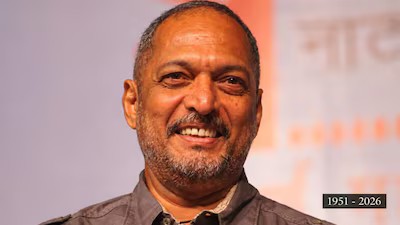
On Thursday morning, Indian cinema lost Nana Patekar at 75 in Goa after a cardiac arrest.
It is difficult to imagine the Hindi film landscape without that voice in it.
For decades, Nana was the actor you could not quite look away from. Not because he was conventionally glamorous or because he carried himself like a star. Quite the opposite. There was always something a little unruly about him. He looked like a man who had wandered into Bollywood by accident and stayed because he found some interesting people there.
That quality made him extraordinary.
Nana understood anger better than most actors of his generation. More importantly, he understood what came before it — love, humiliation, fear, insecurity, loneliness, wounded pride. His characters were rarely simply angry men. They were men who had something to lose.
Watch Agnisakshi. As Vishwanath, the obsessive husband, Nana is frightening precisely because he is not frightening all the time. He can be charming, affectionate and almost boyishly vulnerable before the possessiveness surfaces. Then the mood shifts. The tenderness becomes suffocating. The love becomes frightening. Nana never lets the character settle into one emotion, and that instability makes Vishwanath far more disturbing than a straightforward villain could ever have been. The performance won him the National Film Award for Best Supporting Actor.
This was Nana’s great strength: he could make contradictory emotions live together.
In Parinda, violence had a wounded soul. In Prahaar, military discipline came with idealism and rage. Krantiveer turned his fury into a full-throated challenge to a society he believed had lost its way. Ab Tak Chhappan stripped away the swagger of the cop and showed the fatigue underneath. And in Natsamrat, perhaps his most heartbreaking performance, the man who had spent a career filling rooms with his voice suddenly seemed terribly small and alone.
And then, there was Uday Shetty!
The fact that the same Nana Patekar who could leave an audience shaken in Krantiveer could become one of the great comic presences of Welcome is a reminder of just how much range he possessed.
Uday’s fury over Majnu and Lucky’s incompetence was played with the seriousness of a national emergency. Nana never winked at the audience. He simply played Uday as a gangster who had absolutely no idea how everyone around him could be quite so stupid. The straight face made it funnier. The irritation made it lovable.
Nana could do that. He could make menace entertaining and comedy feel completely natural.
His dialogues became part of popular memory because he never sounded as though he was “delivering" them. In Krantiveer, his famous speech still carries a charge because it feels less like a written monologue than a man finally saying what he has been thinking. Nana later said in one of his interviews, that he did not even remember all of what he had said during the scene. That instinct was central to his acting.
He belonged to the same broad generation as Amitabh Bachchan, Naseeruddin Shah and Om Puri, but Nana never seemed interested in looking or behaving like any of them. He did not cultivate the smoothness that Bollywood usually demands from its stars. He could be blunt, impatient and spectacularly direct.
And he was often misunderstood because of it.
Nana could sound rude. Sometimes, he probably was. But there was very little polish between the thought and the sentence. He said what he felt and dealt with the consequences afterwards. But, there was also a mischievous, unexpectedly tender side to him that did not always make it into the headlines.
He once described his temperament rather perfectly: he could fight with people without carrying a grudge.
That was Nana!
The same man who could be volcanic on screen spent considerable time away from the film industry’s noise thinking about farmers and rural Maharashtra. Along with actor Makarand Anaspure, he helped establish the NAAM Foundation, which worked with drought-hit communities and farmers, including through water conservation and rural development.
It was never really difficult to believe him when he spoke about the dignity of ordinary people. He had never seemed particularly seduced by celebrity himself.
Perhaps that is what separated Nana from so many actors of his generation. He never completely surrendered himself to the idea of being a movie star. He remained stubbornly, sometimes inconveniently, Nana.
There were rough edges. There were controversies. There was the temper. There was the bluntness. But there was also the enormous talent, the generosity, the humour and the ability to make a character feel as if it had walked in from real life rather than been written for a film.
And now he is gone.
The strange thing about losing Nana Patekar is that it does not feel as though an actor has disappeared. It feels as though a particular kind of presence has.
The man who could make a room fall silent with a look. The man who could turn a line into a lifetime’s worth of anger. The man who could terrify us in one film and have us laughing helplessly in the next – Nana never needed to behave like a star.
He was far too busy being Nana!
And Indian cinema, for all its noise, will be a little quieter without him.