
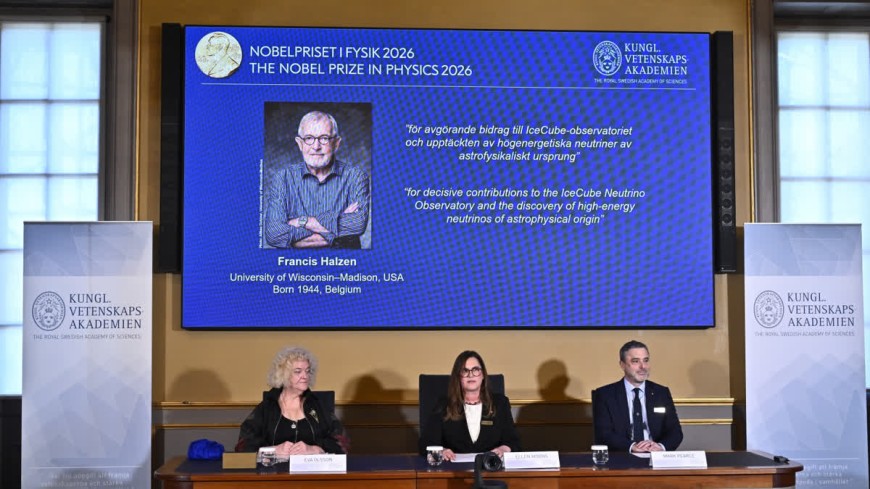
The 2026 Nobel Prize in Physics has been awarded to Francis Halzen "for decisive contributions to the IceCube Neutrino Observatory and the discovery of high-energy neutrinos of astrophysical origin."
The announcement was made on Tuesday by the Royal Swedish Academy of Sciences in Stockholm, Sweden. Francis Halzen was born in 1944 in Tienen, Belgium. He did his PhD in 1969 at KU Leuven, Belgium, and now works as a Professor at the University of Wisconsin-Madison, USA.
According to the official statement released announcing the prize, Halzen realised that ice at the South Pole could be used to track particles known as neutrinos.
"His vision and scientific leadership have been fundamental for the IceCube Neutrino Observatory – a cubic kilometre of ice that is equipped with light sensors. Using IceCube, researchers can capture neutrinos from extremely energy-rich processes in the distant universe," the statement reads.
What Are Neutrinos
Neutrinos are tiny, neutral elementary particles that have almost no mass and pass through normal matter nearly unimpeded, while cosmic neutrinos are a high-energy subset of these particles originating from deep outside our solar system.
"Neutrinos are everywhere, but they do not make themselves known. They pass all the way through the Earth and through our bodies without us noticing. Very rarely, a single neutrino will interact with an atomic nucleus, which makes it possible for someone with the right equipment to discover them," the statement reads.
Scientists, it says, have long known that the cosmos contains natural particle accelerators, which fire out particles with energies up to a million times more than can be achieved in laboratories on Earth.
The statement pointed out that much about these sources is mysterious: what are they, where are they, and what are the main processes inside them?
"Neutrinos with extremely high energies are created in the same environments as other types of particles. However, unlike other particles, neutrinos reach us without changing direction or losing energy. This means they can provide information that is not available in any other way."
The statement said that Halzen first presented his vision for capturing neutrinos at the South Pole in 1988.
"When a neutrino collides with an atomic nucleus, it produces a flash of light that can be tracked by sensors in the clear glacial ice. The South Pole’s ice has many advantages, as it is free from various types of interference and the area is geologically stable, with no earthquakes. Halzen and his idea soon gained the support of other researchers and, just a few years later, preliminary testing was conducted on sensors in ice," it said.
IceCube Observatory And Cosmic Neutrinos
IceCube, the South Pole neutrino observatory, is a cubic-kilometre particle detector made of Antarctic ice and located near the Amundsen-Scott South Pole Station, according to the observatory website. The detector is buried beneath the surface, extending to a depth of about 2,500 meters. Using IceCube, researchers can capture neutrinos from extremely energy-rich processes in the distant universe, the Nobel statement said.
Cosmic neutrinos with extremely high energies, it explained, are very rare, so an enormous volume of ice is needed to observe an adequate number of collisions.
"Francis Halzen has led an international team of researchers and engineers who have provided us with a fantastic instrument. His tenacity and scientific vision has paved the way for a new kind of astronomy,” says Mark Pearce, Chair of the Nobel Committee for Physics.
The neutrino interactions that are continuously collected by IceCube will provide researchers with novel knowledge about the violent settings in which high-energy neutrinos can be created – and could even reveal previously unknown cosmic phenomena, the statement added.
Medicine & Physics Done, Chemistry Award On Wednesday
The announcements of this year's prizes began Monday with the Nobel Prize in Medicine awarded to three scientists whose work led to a tool that uses light to help unravel how the brain works.
Today's physics prize will be followed by the chemistry prize on Wednesday. The literature laureate will be revealed on Thursday and the perhaps most keenly anticipated award–the peace prize–is due on Friday. The economics prize wraps up the Nobel season on October 12.
2025 Physics Awardees
Last year, physicists John Clarke, Michel H Devoret, and John M Martinis were awarded for "the discovery of macroscopic quantum mechanical tunnelling and energy quantisation in an electric circuit."
The Nobel Prize in Physics has been awarded 119 times to 230 Nobel Prize laureates between 1901 and 2025, according to the official website of The Nobel Prize. John Bardeen, it says, is the only laureate who has been awarded the Nobel Prize in Physics twice, in 1956 and 1972. This means that a total of 229 individuals have received the Nobel Prize in Physics.
Nobel Prize Money Increased By SEK 1 Million
The prize money this year is 12 million Swedish kronor (over Rs 11 crore). If a specific category has multiple winners, like Medicine on Monday, this amount is divided equally among the laureates.
The prize money was increased by 1 million kronor (over Rs 96 lakh) this year. Hanna Stjärne, Executive Director of the Nobel Foundation, said the hike in the prize money was done "to uphold the long-term significance of the Nobel Prize and ensure that the financial part of the prize retains its value over time".
In 1901, when the Nobel Prizes were first announced, the prize amount was SEK 150,782 per prize category. Over the last 15 years, the amount has been adjusted several times. In 2012, the prize money was reduced from SEK 10 million to SEK 8 million. It was increased on three occasions since then.