
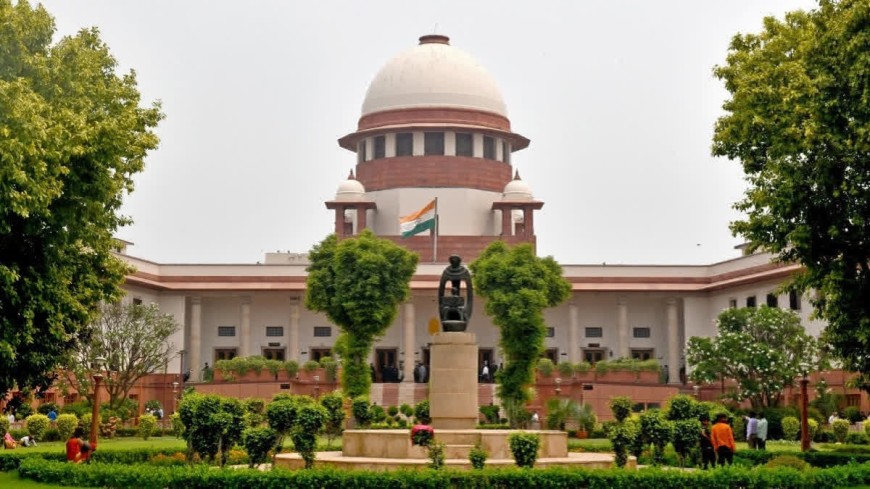
New Delhi: The Supreme Court on Monday observed that soaring and opaque drug pricing is inflicting suffering on the common man, citing stark anomalies between marked retail prices and the sums hospitals effectively extract.
The apex court highlighted examples, including an injection with an MRP of Rs 22,437 while the price to the retailer is only about Rs 3,520. Questioning who ultimately pockets the difference, the court stressed that patients are eventually compelled to buy medicines from in‑house chemists of hospitals and if the drug is procured from an outside chemist at a lesser price, the patient may doubt its genuineness.
The apex court suggested a simple, uniform remedy: cap margins at 16?ove MRP, as envisaged under the Drugs (Prices Control) Order, to curb profiteering and protect taxpayers.
The matter was heard by a bench comprising Justice Vikram Nath and Sandeep Mehta. The bench was hearing two petitions that raised drug-related issues, including ensuring strict price control over medicines.
During the hearing, Additional Solicitor General Aishwarya Bhati submitted a note stating that she had brought the entire regulatory framework and its rationale on record for the bench's perusal.
Solicitor General Tushar Mehta also joined the proceedings before the bench. Mehta said if the court permits, he will have a meeting with the concerned officers and emphasised resolving the matter, adding, "some way which balances equity has to be found."
Justice Mehta said, "Why this distinction: essential and non-essential (medicines). Why not keep 16% margin on MRP which is prescribed in the DPCO [The Drugs (Prices Control) Order] on everything. Why not? Ultimately, the result is the taxpayer (is paying)…”
Referring to private hospitals, the bench cited an example of a cancer drug where the MRP is Rs 27,000 and the Price to Retailer (PTR) is around Rs 3000, urging the government's counsel to see the drastic difference.
"A corporate hospital, as everyone knows, says that you have to buy from our chemist. If you bring it from outside, we are not assuring you of the treatment; what does the patient do? Suppose the patient is taking treatment under some government scheme, who reimburses?” observed Justice Mehta.
To the Solicitor General saying that the government pays, Justice Mehta countered that the government "does not pay but the taxpayer pays and that is where the game is".
"Why not a uniform criterion of 16?ove MRP, nothing beyond that. DPCO says 16%," said the bench, and referring to the petitioner’s contention, added that every medical device and every medicine is covered under the Essential Commodities Act. "So, if it is an essential item, can it be left out of DPCO?” asked the bench.
The Solicitor General said it appeared to be a "logical way".
The bench further added that if a chemist sells a Rs 27,000 MRP medicine to a patient for Rs 3000 on humanitarian basis, the patient would doubt whether the medicine is genuine?
What kind of confusion is being created? Tell why this difference is and where does this money go? Where does this chunk of money go, 10 times (the MRP)?”, asked the bench, adding that though the PTR is one-tenth of the MRP.
Solicitor said with his understanding of the matter, the gainer is the private hospital and not the pharma company, and ultimately, the loser is the taxpayer. The bench was informed that patented medicines fall outside the ambit of DPCO. "Ultimately, the pharma companies have not bothered. We don’t know why they are asked to fix this price. This is carnage, plain and simple," said Justice Mehta.
The bench referred to Exemptia 20mg, an injection, and added that its MRP is Rs 22,437, and the price to the retailer is Rs 3520. Justice Mehta said people can get the drug from a chemist for a lesser price, but the corporate hospitals won't spare anyone, adding, "They do not even allow a dead body to be taken out. Why should a common man suffer all this?”
The bench has fixed the matter for further hearing the second week of October.
On September 22, the Supreme Court expressed anguish after being apprised that there was a huge difference between the MRP and the PTR prices of essential cancer medicines. The apex court did not mince words, describing the situation as “broad daylight dacoity,” and condemning the pricing as extortion, an “absolute rampage,” and “carnage” against patients and wondered why authorities are silent on it.
One of the petitions sought a direction to authorities to make drug formulations more cost-effective by preventing alleged unethical overpricing of essential medicines by pharma companies and retailers.